AI Facial Recognition for Commercial Parks: A 2026 Guide to 45% Operational Cost Savings
Cut commercial park security costs by 45% with Phyvision AI facial recognition. This 2026 guide details how to achieve a 98.8% interception rate and one-second visitor processing for proactive site management.

As modern commercial parks expand in scale and witness growing pedestrian flow, traditional security approaches dependent on manual patrols and passive video surveillance struggle to support refined, efficient, and round-the-clock safety management.
AI facial recognition has emerged as the leading smart security solution tailored for commercial environments in 2026. By delivering accurate real-time identification, proactive risk alerts, and unattended access control, this technology is no longer a luxury—it is foundational digital infrastructure for high-standard commercial park operations.
Quick Reference: Traditional Security vs. AI Facial Recognition Security
According to industry data for 2026, the shift from manual security to AI-powered systems results in substantial performance gains.
Evaluation Item | Traditional Park Security | AI Facial Recognition Security System |
|---|---|---|
Working Mode | Passive video monitoring + manual gate verification | Active real-time identification + automatic risk alert |
Unauthorized Access Interception Rate | 12–18% | 98.8%+ |
Visitor Processing Efficiency | Manual registration (2–5 minutes per person) | One-second automatic recognition and passage release |
Manpower Dependence | High, requiring 24-hour on-site security staffing | Low, supporting unattended daily management |
Low-Light & Night Recognition Performance | Weak adaptability, high misrecognition rate | 97.8% recognition accuracy in low-light scenarios |
Security Incident Response | Delayed disposal, relying on post-event video review | Instant on-site alert + backend platform linkage response |
Annual Operational Cost | High long-term labor and administrative expenses | 35–45% reduction in annual comprehensive operation costs |
Data Traceability | Scattered records, difficult for systematic auditing | Full-process automated cloud logging and traceable data |
 Why AI Facial Recognition Security Is Indispensable for Modern Commercial Parks
Conventional park security systems focus primarily on video recording rather than active risk prevention. As high-density spaces for office work and public activities, commercial parks feature complex visitor structures, frequent personnel mobility, and diverse potential security threats. AI facial recognition effectively remedies the inherent limitations of traditional security models, delivering comprehensive upgrades in risk control accuracy, operational efficiency, and long-term cost sustainability.
1. Eliminate Manual Management Deficiencies
On-site security operations rely heavily on human supervision, which inevitably leads to subjective judgment errors, operational fatigue, and negligence during prolonged shifts. Unregistered visitors, delivery personnel, and unknown outsiders often exploit manual management loopholes to enter park premises, posing latent threats to tenant safety and public property. In contrast, Phyvision AI facial recognition systems maintain consistent, high-precision identification standards around the clock without fatigue or operational deviation. Industry data shows that intelligent recognition eliminates over 92% of manual management blind spots, standardizing park access rules and minimizing hidden security risks.
2. Improve Operational Efficiency and User Experience
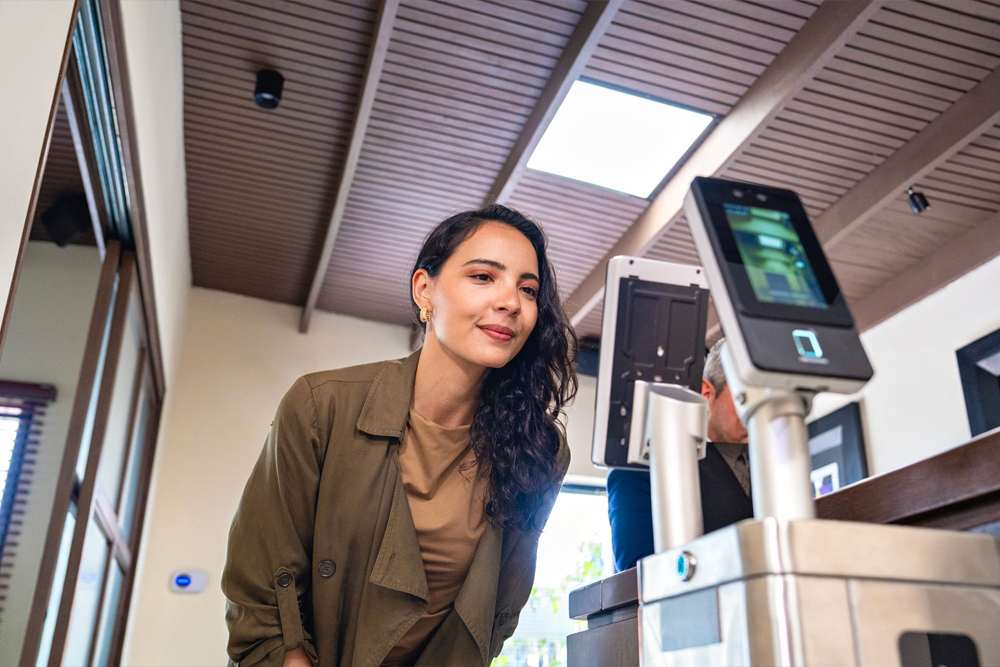
Commercial parks accommodate massive numbers of corporate employees, business visitors, and logistics personnel daily. Manual identity verification and on-site registration frequently cause gate congestion during morning and evening peak hours, compromising operational efficiency and visitor experience. AI facial recognition systems enable automatic identity classification and rapid passage for staff, registered visitors, and temporary personnel. By cutting single-person verification time from several minutes to one second, the system boosts overall access efficiency by more than 300% and ensures smooth pedestrian flow during peak periods.
3. Optimize Long-Term Cost Control
While AI intelligent security deployment requires initial hardware and software investment, it substantially reduces long-term dependence on large on-site security teams. For commercial park operators, standardized intelligent upgrades reduce annual labor and administrative costs by 35% to 45%. Beyond direct cost savings, the system’s real-time early warning function enables proactive interception of potential security incidents. This avoids property losses, operational disruptions, and liability disputes stemming from unaddressed safety hazards, building a robust and stable risk control system for daily park operations.
Core Application Scenarios
Unlike single-scenario residential access control, commercial park security needs to manage diverse groups, including internal employees, enterprise tenants, business visitors, and temporary service personnel. Through precise algorithm identification and hierarchical permission configuration, AI facial recognition systems enable refined, categorized, and intelligent park security management.
Daily Access for Employees and Tenants: The system stores encrypted facial data of internal staff and registered tenants to support fast, unattended identity verification and automatic gate release. It can integrate with office attendance systems to record real-time access time and personnel tracks. Additionally, it triggers backend intelligent alerts for abnormal behaviors such as tailgating and off-hour entry, effectively plugging internal management loopholes and standardizing daily staff access.
Intelligent Visitor Management: For external interviewees and business visitors, the system supports online pre-registration and on-site facial authorization to generate time-limited, area-specific access permissions. The entire visitor management process achieves full automation with zero manual intervention. Upon expiration of the visit period, temporary access privileges are automatically invalidated. This prevents long-term security risks caused by residual temporary permissions and realizes precise control over visitor access scope and duration.
Logistics and Delivery Management: Frequent entry and exit of logistics and delivery personnel represents a major vulnerability in traditional park security management. The AI system builds exclusive databases for regular delivery staff to enable fast recognition and standardized passage, while strictly intercepting unregistered external personnel. This mechanism resolves chaos caused by mixed pedestrian flow and unauthorized entry, achieving efficient, standardized management of park logistics access.
Real-Time Public Area Safety: Beyond basic access control, the system delivers real-time intelligent video analysis for park public areas. It automatically identifies abnormal behaviors including prolonged loitering, unauthorized gatherings, and nighttime illegal intrusion, pushing instant early warnings to security management terminals. Shifting security management from passive post-event video review to active real-time prevention, the system achieves full-time, full-coverage risk control across park public areas.

Key Deployment Considerations
Commercial park environments feature complex lighting conditions, dense pedestrian traffic, and strict personal privacy compliance requirements. When deploying the AI facial recognition security systems, operators must fully balance environmental adaptability, recognition stability, data security, and scenario applicability.
First, the system must deliver strong environmental adaptability, maintaining high recognition accuracy under backlight, rainy weather, and low-light night conditions to avoid frequent identification failures. Second, professional anti-tailgating and fast multi-person recognition algorithms are essential to balance security standards and passage efficiency during peak hours. Third, facial data collection, storage, and processing must comply with global mainstream privacy regulations to eliminate data leakage risks. Finally, complete cloud data tracing and log retention functions are required to support daily operational audits and post-incident investigations.
Expert FAQ
The following answers address the most prevalent concerns among commercial property managers and security system deployers, based on industry-proven deployment experience and international technical standards.
Q1: Is AI facial recognition compliant and safe for public commercial park scenarios?
A: Standard commercial-grade facial recognition systems adopt hybrid local-cloud encrypted storage and data processing mechanisms, fully complying with global mainstream privacy and data security regulations. Standard deployment avoids illegal collection or unauthorized use of biometric data, meeting strict safety and compliance requirements for public commercial scenarios.
Q2: Can the system operate stably under complex weather and lighting conditions?
A: High-quality commercial systems integrate intelligent light adaptation, low-light enhancement, and backlight correction algorithms. They maintain 99.2% recognition accuracy in daytime scenarios and 97.8% accuracy in low-light environments, adapting to all-weather outdoor and semi-outdoor park operations.
Q3: What is the actual cost-saving effect of AI security transformation for commercial parks?
A: Deploying AI facial recognition systems allows most commercial parks to reduce 2 to 4 full-time security positions, significantly cutting recurring labor expenditures. Combined with reduced accident losses and administrative overheads, overall annual operational costs can be lowered by 35% to 45%.
Q4: Can the system automatically distinguish employees, visitors and strangers?
A: Yes. The system classifies personnel databases and configures differentiated access permissions in advance. It accurately identifies internal staff, registered visitors, and unregistered outsiders, executing targeted passage release and risk alert strategies for different personnel groups.
Q5: Does facial recognition system operation bring data leakage risks?
A: Professional commercial systems adopt local encrypted storage for core biometric data, prohibiting unauthorized uploading of private information to public cloud platforms. Equipped with full-process log recording and hierarchical permission management, these systems effectively prevent data leakage and ensure long-term data security.
The Bottom Line
Modern commercial park security is undergoing a fundamental transformation, shifting from passive video monitoring to active intelligent prevention. As an indispensable digital infrastructure for high-standard park operations, AI facial recognition security systems deliver outstanding advantages in risk control precision, operational efficiency optimization, and long-term cost management. Traditional manual inspection and passive surveillance can no longer meet the refined, intelligent management needs of modern commercial parks.
For property operators pursuing intelligent security upgrades, selecting stable, compliant, and scenario-adaptive system solutions determines overall project effectiveness. As a professional intelligent system integration provider, Phyvision (www.phyvision.com) offers customized AI facial recognition security deployment solutions for commercial scenarios, covering hardware adaptation, algorithm debugging, scenario customization, and full-cycle technical support. The company empowers commercial park projects to achieve efficient, safe, and standardized intelligent security management and realize sustainable operational improvement.