Access Control Credentials, Integration & Sourcing: Biometric, Mobile & China Procurement Guide
Beyond hardware lies the intelligence layer: credential technologies, system integration, and sourcing strategy. This guide examines smart cards, mobile BLE/NFC, and biometric authentication, maps out CCTV and elevator integration workflows, and provides a practical procurement checklist for certified access control hardware from Chinese manufacturers.
Once the access control architecture and topology are established, the next decisions determine how identities are verified at every door and how the access system communicates with the broader security ecosystem. Credential technology and system integration are where security policy meets daily user experience — a poorly chosen credential creates friction for tenants, while weak integration leaves security value unrealized. This guide covers credential selection, CCTV and elevator integration, and a practical framework for procuring certified hardware from Chinese manufacturers.
Credential Technologies: Card, Mobile, and Biometric
Credential technology is not a single decision applied uniformly to every door — it is a zone-based specification that applies different credential requirements to different security zones within the same building. The lobby turnstile may require mobile BLE for speed, while the server room mandates biometric + card.
Smart Cards (13.56 MHz)
MIFARE DESFire and HID iCLASS are the enterprise standard for card-based credentials. Unlike 125 kHz proximity cards that transmit a static ID in plaintext, smart cards use mutual authentication and AES-128 encrypted data exchange, and can store multiple applications — access control, biometric template, and cashless payment — on a single card.
Mobile Credentials (BLE/NFC)
Smartphone-based access using Bluetooth Low Energy or NFC is the fastest-growing credential segment, projected to account for over 40% of new office building access credentials by 2028. Mobile credentials eliminate physical card issuance costs, enable remote provisioning and revocation, and solve the “forgotten card” problem. The system must support both BLE for hands-free vehicle entry and NFC for pedestrian doors from a single reader.
Fingerprint Recognition
Optical and capacitive fingerprint readers are cost-effective biometric credentials for interior office doors and server rooms. Accuracy has improved significantly: leading sensors now achieve False Acceptance Rate below 0.001% and False Rejection Rate below 1%. Critical specification: biometric templates must be stored on the access controller or management server, not on the reader itself — readers that store templates locally are a data privacy risk if stolen.
Facial Recognition
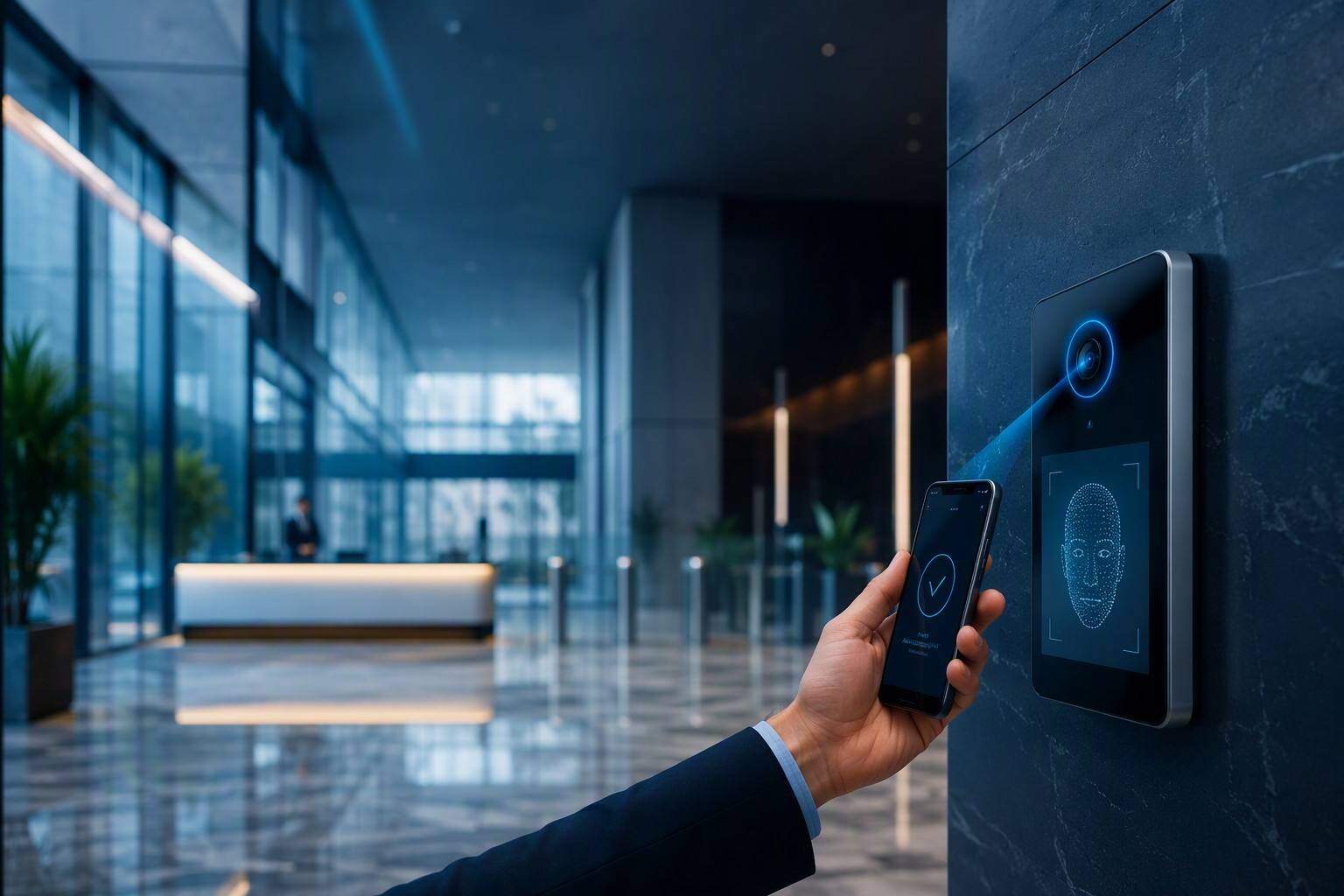
AI-powered facial recognition readers using IR-illuminated stereo cameras achieve sub-0.001% FAR at a 1.5-meter recognition distance with mask detection. Liveness detection (anti-spoofing against photos, videos, and 3D masks) is mandatory for any deployment. Phyvision facial recognition readers carry iBeta Level 1 certification, with Level 2 available for high-security deployments.
Multimodal and Multi-Factor Authentication
Enterprise security policy increasingly mandates multi-factor authentication for high-security zones: card + PIN for server rooms, biometric + card for data centers, mobile credential + PIN for after-hours building access. The access controller must support multi-factor rules configurable per door and per schedule — a door that requires card-only during business hours may require card + biometric after hours.
System Integration: CCTV, Visitor Management, Elevator & Fire Alarm

An office building security system achieves its full value only when access control integrates with complementary security and building management systems. Standalone access control — doors that lock and unlock without sharing data — leaves significant security value unrealized.
CCTV Integration
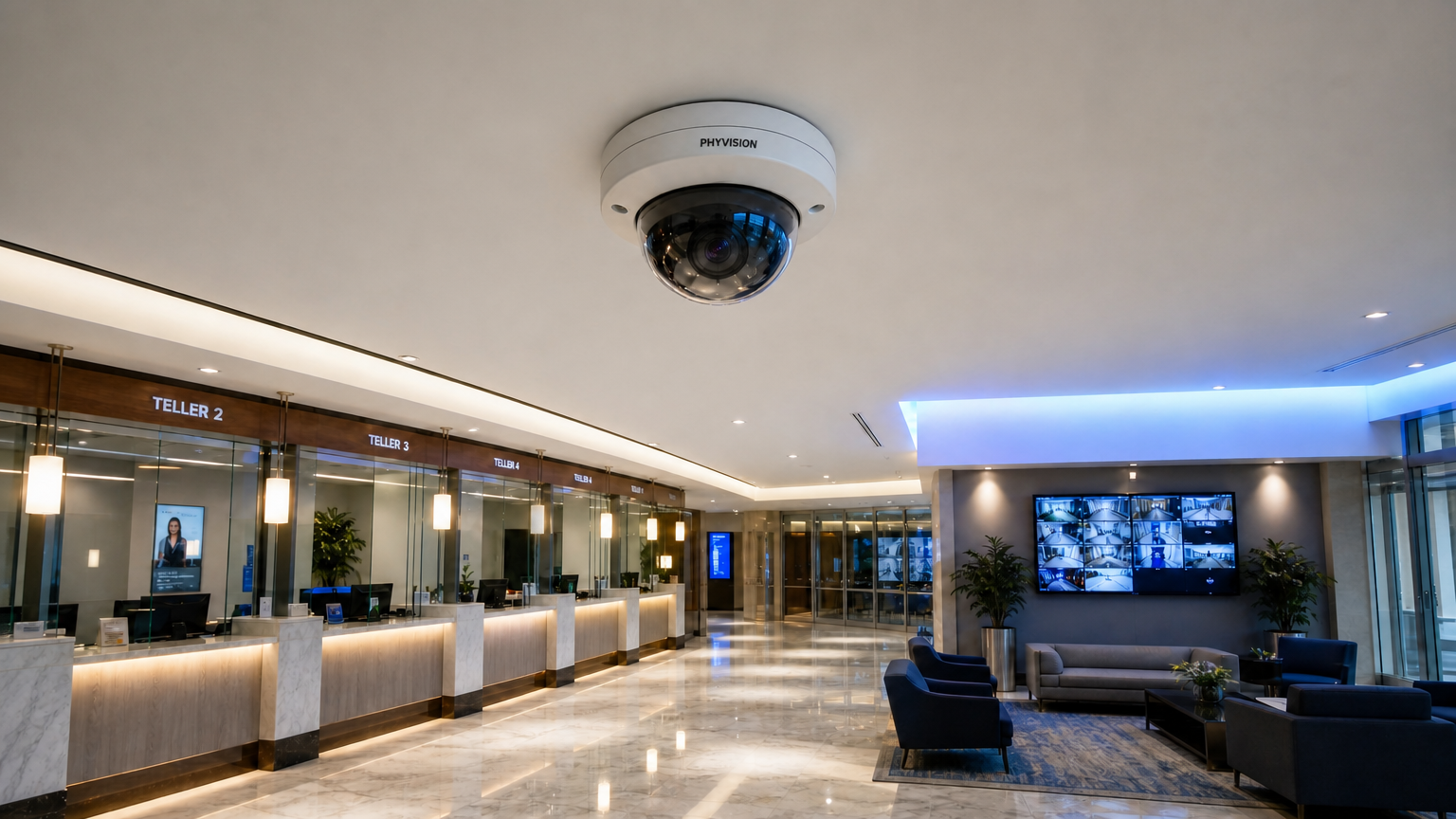
Access control events trigger CCTV recording actions: a door forced-open alarm automatically commands the nearest PTZ camera to a preset position and increases recording quality for the duration of the alarm. A valid access grant triggers a high-resolution clip with cardholder photo and name overlaid. Integration requires the access controller and VMS to communicate via dry contact relay for basic alarm triggering, HTTP API for event-driven commands, or ONVIF Profile C for standardized integration.
Visitor Management Integration
Visitor access should follow an automated lifecycle: pre-registration by the host tenant, issuance of time-limited credentials with host-floor-only access, automatic expiration, and daily audit reporting. Integration between the visitor management platform and the access control system automates this lifecycle entirely — without integration, each step requires manual data entry by security staff.
Elevator Destination Dispatch & Fire Alarm Integration
In multi-tenant office towers, access control integration with elevator control restricts tenant-floor access while permitting common-floor access. A tenant employee presents their credential at the lobby turnstile; the system grants entry and commands the elevator to the authorized floor. Fire alarm integration is a mandatory code requirement: a dry contact relay from the fire alarm control panel cuts power to fail-safe locks on all fire egress routes when the alarm activates, ensuring egress doors unlock regardless of access control system status.
Sourcing Access Control Hardware from China
Chinese manufacturers have captured an estimated 25–30% of the global access control hardware market by unit volume, with particular strength in controllers, readers, electromagnetic locks, and complete door access control system packages. The cost advantage — 35–50% below US and European equivalents — is structural, driven by supply chain density. However, access control procurement requires verification criteria distinct from CCTV procurement, particularly around interoperability and safety certification.
Controller Interoperability
The access controller is where ecosystem lock-in is most prevalent. Before procurement, confirm: OSDP v2.1.7+ for reader communication, ONVIF Profile A for system interoperability, and a documented RESTful API. Controllers using only Wiegand and proprietary protocols create a closed ecosystem that constrains future expansion.
Reader Certification and Accuracy
Biometric readers, particularly facial recognition, are subject to accuracy claims that may not be independently verified. Before procurement, request: FAR and FRR tested by an ISO/IEC 19795-compliant independent laboratory, liveness detection certification (iBeta Level 1 or Level 2), and the operating conditions within which stated accuracy is maintained.
Electromagnetic Lock Certification
Maglocks are safety-critical components. Confirm: UL 294 listing for the US market, CE marking with EN 14846 compliance for the EU market, and fire rating certification for installation on fire-rated doors. A maglock without fire rating certification cannot be installed on fire egress doors without violating code and voiding building insurance.
Phyvision Access Control Program
Phyvision supplies authorized distributors and system integrators with networked and cloud-managed access controllers, OSDP-compatible biometric readers, 600 lbs electromagnetic locks, and complete door access control system office packages. All hardware is CE, FCC, and RoHS certified. OEM orders start at MOQ 50 units for controllers and readers, 100 units for locks, with 7–15 day lead times. Free evaluation kits are available for qualified buyers.
Procurement Verification Checklist
Criterion | What to Verify | Red Flag | Phyvision Status |
|---|---|---|---|
Controller | OSDP v2.1.7+, ONVIF Profile A, RESTful API | Wiegand only, proprietary protocol | ✓ OSDP + ONVIF + API |
Reader Encryption | OSDP Secure Channel, AES-128 | Wiegand plaintext | ✓ OSDP SC supported |
Biometric Accuracy | Independent lab test report, FAR/FRR | Self-claimed accuracy | ✓ Available on request |
Liveness Detection | iBeta Level 1 or 2 certification | No anti-spoofing | ✓ iBeta Level 1 (facial) |
Maglock Cert. | UL 294 / EN 14846 / fire rating | No certification | ✓ CE, fire-rated models |
Cloud Security | SOC 2, ISO 27001, data residency | No security certification | ✓ ISO 9001, ISO 27001 in progress |
API Docs | Publicly documented RESTful API | No API, proprietary only | ✓ Full API documentation |
FAQ
Q1: What is the difference between OSDP and Wiegand?
Wiegand is a legacy protocol that transmits card data in plaintext with no encryption or mutual authentication. OSDP (Open Supervised Device Protocol) supports AES-128 encrypted communication, reader tamper detection, firmware updates, and biometric data transmission. OSDP v2.1.7+ is the recommended standard for all new installations.
Q2: Can mobile credentials fully replace physical access cards?
Mobile credentials can replace approximately 85–90% of physical card use cases — employee access, visitor access, and parking entry. The remaining 10–15% require card backup: building engineering staff whose phones may be damaged in mechanical rooms, contractors who should not receive mobile app access, and legacy elevator/parking systems with embedded card readers. The standard specification is mobile-primary with card-backup, not mobile-only.
Q3: What is the typical budget for a 50-door office building?
A 50-door deployment with networked controllers, OSDP smart card readers, 600 lbs maglocks, exit devices, power supplies, and a cloud management platform typically ranges from $35,000 to $65,000 for hardware, depending on credential type. Chinese-manufactured hardware reduces the controller, reader, and lock component by 35–50% — approximately $12,000–22,000 saved on a 50-door deployment.
Q4: How does access control integrate with fire alarm systems?
Fire alarm integration uses a dry contact relay from the fire alarm control panel to the lock power supply. When the alarm activates, the relay cuts power to fail-safe locks on all egress routes — unlocking those doors regardless of access control status. This must be tested during fire system commissioning. Fail-secure locks on non-egress doors do not release during fire alarm activation.